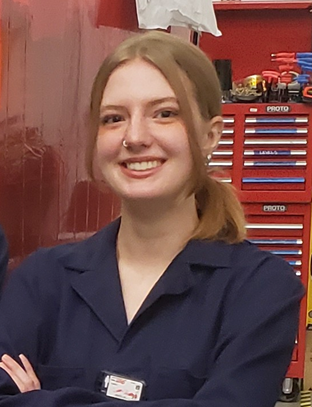
Olivia Nippe-Jeakins – Toni and Hans Schierling Undergraduate Scholar
1st Year Scholar, Undergraduate
Astronomy & Astrophysics/Physics
George Washington University
Research:
My work focuses on improving models of the emission from gamma-ray bursts in X-ray and optical light, which occurs after the initial burst, to study particle acceleration and radiation mechanisms in the jets emanating from these sources.
How Will Your Research Benefit Society?
Mankind has always been fascinated by fundamental questions about the cosmos and our place within it. Astronomy, including the study of cosmic explosions, has the ability to draw public interest and is a good way to get children and the general population passionate about science. In the effort to understand the processes that govern the cosmos, numerous technologies have been developed in order to improve astronomical telescopes and detectors. These technologies often end up having broader applications, like with the development of the Global Positioning System (GPS), solar panels, and even medical imaging devices like MRIs. Current work being done in the field will likely see similar impacts in the future as we continue to probe deeper and deeper into the universe and the extreme phenomena it harbors.
How will an ARCS Award Benefit Your Research?
An ARCS award would provide important support for me to focus on my research without needing to concern myself with finding additional sources of income during the academic year. This award would also allow me to travel to conferences to network and present my work. As I enter [the] fall semester, I will begin the PhD program application process. Attending conferences, like The Physics and Astronomy Congress, will offer me valuable face time with researchers and faculty from the graduate programs I am applying to. Receiving this award will also then free up more departmental funds to cover the costs of more of my peers traveling and presenting at these types of professional conferences.
Career objectives:
My long-term goal is to build a career in nuclear astrophysics research, ultimately becoming a research professor at a university or staff scientist at a national lab. I am currently looking into PhD programs in this field, which I will be applying to this fall. My interests lie at the intersection of astrophysics and nuclear physics, and primarily with the study of extreme cosmic environments.