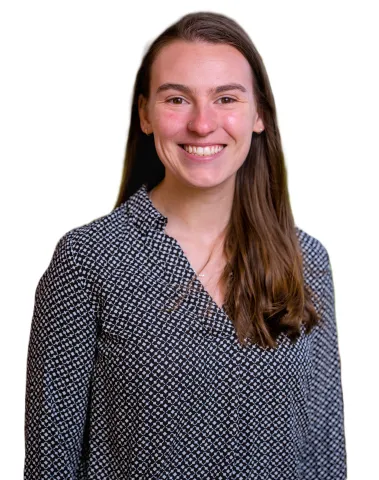
Scholar Spotlight: Lauren Bowling
Lauren Bowling – JCM Foundation Scholar
1st Year Scholar, PhD candidate
Material Science & Engineering
University of Virginia
Research:
Current materials used in gas turbines and aeroengines will not survive at the elevated temperatures required in next generation engines; therefore alternative materials must be employed. Refractory alloys are possible candidates due to their high melting points and strength, but suffer from catastrophic oxidation at these application temperatures. My research focuses on identifying refractory alloy compositions and oxides that can reduce oxidation and improve the performance of materials used in next-generation gas turbines and aeroengines.
How Will Your Research Benefit Society?
The use of refractory alloys within engines will increase the operational temperature limit of the engine, which improves its efficiency and will directly benefit both the defense industry and the environment. In the defense sector, increased engine efficiency extends the range that hypersonic vehicles can travel and can also reduce operational costs. These advances contribute to the development of advanced high-temperature materials and hypersonic systems, which are currently designated as critical technology. With respect to the environment, an engine with increased efficiency will burn less fuel, which lowers the CO2 emissions and improves the sustainability of civil air travel.
How will an ARCS Award Benefit Your Research?
An ARCS award would benefit my research through supporting more rigorous experimental and characterization campaigns. The oxidation behavior of materials is dependent on exposure conditions (i.e., time and temperature), meaning that performing exposures with numerous time intervals and temperatures would promote a more robust understanding of the material’s oxidation mechanisms. Support from ARCS would assist with additional tests for extended periods of time and at increased temperatures, which would also increase the novelty of the research. Additionally, the use of advanced characterization techniques can provide insight into nanoscale features and mechanisms that more traditional and less costly techniques are unable to resolve.
Career objectives:
After completing my PhD, I hope to apply my skills and knowledge to explore the realm of aerospace materials by working in industry. I plan to continue to build my experiences and broaden my understanding in this field before ultimately returning to academia to teach and excite the next generation of STEM students.
- Log in to post comments