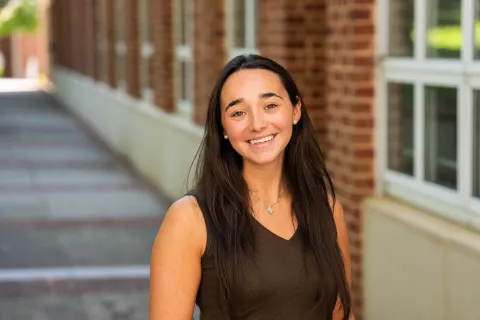
Scholar Spotlight: Hayden Barry
Hayden Barry – Forster Family Foundation Scholar
1st Year Scholar, PhD Candidate
Materials Science and Engineering
University of Virginia
Research:
My research focuses on improving superconductor-insulator-superconductor junctions, which act as tiny, ultra-fast switches that are the building blocks of future quantum computers and advanced sensors. By using a Transmission Electron Microscope (TEM), a tool powerful enough to see individual atoms, we investigate how tiny flaws at the junction's edges can slow down or disrupt the signal. This allows us to map out microscopic defects and learn how to build more perfect, efficient hardware for faster data processing and better space-exploration tools.
How Will Your Research Benefit Society?
The research enables the development of ultra-fast, energy-efficient quantum computers and high-sensitivity space sensors by using atomic-resolution microscopy to eliminate microscopic defects in superconductor-insulator-superconductor junctions. By mastering these materials, we can provide the foundational technology for safer nuclear energy and more efficient solar power, ultimately significantly improving energy security.
How will an ARCS Award Benefit Your Research?
An ARCS award would provide the critical financial support and professional recognition necessary to accelerate the development of a predictive design framework for next-generation superconducting digital logic and quantum sensing platforms. Specifically, this fellowship would facilitate the complex, multi-modal characterization of NbTiN-based SIS junctions using advanced techniques like monochromated EELS and 4D-STEM, allowing for a deeper investigation into how atomic-scale defects and grain morphology govern macroscopic quantum transport. Beyond technical resources, the award supports the dissemination of these findings to the broader scientific community, helping to bridge the gap between atomistic interface engineering and the deployment of robust materials for high-thermal-budget SDL circuits and advanced nuclear reactor sensing.
Career objectives:
I hope to stay in academia and become a professor of Materials Science Engineering.
- Log in to post comments