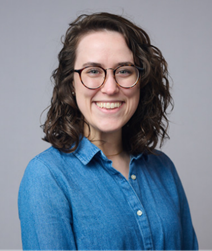
Phoebe Sharp – MWC Chapter Scholar
1st Year Scholar, PhD candidate
Computer Science & Physics
George Washington University
Research:
A handful of the protons and neutrons inside the nuclei of all atoms are found to be coupled together in pairs, a phenomenon called Short Range Correlations (SRCs). These pairs need to be studied with several different techniques to see if our understanding is self-consistent or biased by the conditions of any single technique. SRCs are fascinating to study because they can help us understand the building blocks of our universe from the atoms that compose all of us, to the material inside neutron stars light years away.
How Will Your Research Benefit Society?
Understanding SRCs contributes greatly to our understanding of the forces between protons and neutrons, knowledge which carries a wide variety of applications. Understanding these forces is a key goal of the field of nuclear structure, and will help underpin nuclear technology of the future. These forces also play a role in the evolution of stars and other astrophysical objects, helping to give us a better understanding of our place in the cosmos. More immediately, the technical challenge of these experiments drives the development of new technology in magnets, semi-conductors, and high-performance computing. The research also trains the next generation of scientific work force that will advance technological progress across many fields.
How will an ARCS Award Benefit Your Research?
First, I live in Newport News in order to work on-site at Jefferson Lab and collaborate with scientists there. However, this greatly limits the face-to-face time I get with my advisor. An ARCS award would permit more frequent travel to DC this year, as I work to converge my analysis. Second, ARCS funding would give me the opportunity to travel to more conferences, present my work, and network at a time when I’m about to enter the job market. The timing of these meetings will likely allow me to present my thesis results to the wider nuclear physics community beyond that of Jefferson Lab. When I’m using this award to support my travel, my research group can support additional students to travel, creating more space for students and their research in our group.
Career objectives:
Alongside my decade-long education in physics, I have learned about the importance of community. My community for doing homework, the broader community for graduate students in physics, my external physics community, my family, and many more, are how I’ve been able to make it in physics this long. My goal for my career is to use these community building experiences to strengthen the public’s trust, capability, and confidence in science, and I’m exploring what this can look like in different settings.